
Find Who Owns Echols County Property
Ownership research in Echols County climbs a short evidence ladder. An address locates a candidate parcel in the property search. The assessor then publishes an owner or taxpayer field for that parcel number. Finally, the deed index names the grantee in the recorded transfer. Each source answers a different question. Preserve every exact label and date you find.
- Normalize the location. Compare the situs with the Echols road index, keeping highway, state-route, directional, and community-name variants.
- Identify the tax parcel. Open county-linked qPublic and save the published owner label, parcel identifier, situs, mailing address, legal description, tax year, and search date if visible.
- Trace the name to a deed. Search GSCCCA in Echols County for the likely grantee, then check the grantor side and recording reference.
- Resolve a recent or indirect change. Ask the Clerk about the latest image; use probate records when an estate or court order explains the transfer.
Use the current-owner detail to judge how fresh the published owner field is, former owners to build a backward chain, and deed records for instrument retrieval.
Start an Echols Owner Check at qPublic
The Echols County Tax Assessor links the official qPublic portal. It also states that assessor information reflects the current published tax digest. The direct Schneider application sits behind an access challenge at times. Its exact search fields can therefore vary from visit to visit. The owner label and parcel format can vary too. Use the portal freely. Just describe controls you actually see on screen rather than promising ones. When the parcel card loads, capture the owner label exactly as shown. "Taxpayer" is not the same thing as "legal owner." Save the mailing address and the situs address separately, too. The mailing address may belong to an out-of-county owner. It may also belong to an estate representative or a tax service. It never proves the owner lives there. If access is blocked, the Echols County Tax Assessor can help. Reach the office at 229-559-7370 or 110 Highway 94 E, Statenville. Ask for the published parcel card and its tax year or as-of date.
Trace an Echols Property Owner to Deeds
The Clerk of Superior Court maintains all Echols County real-estate recordings. In the GSCCCA name search, select Echols County. Search the likely owner as grantee. Use last-name-first format for an individual. Then search the same party as grantor. Record the instrument type, recording or index date, book and page. Note the legal description, related documents, and whether an image exists. A free limited-use account may expose index and summary data. Images and printing follow account rules. Confirm the actual instrument with the Clerk at 110 Highway 94 E, Statenville, 229-559-5642. An index hit identifies a filing. It does not replace reading the deed's vesting language and legal description yourself. The statewide Real Estate index page lets you pick a county. It also accepts party names: open the statewide Real Estate index.
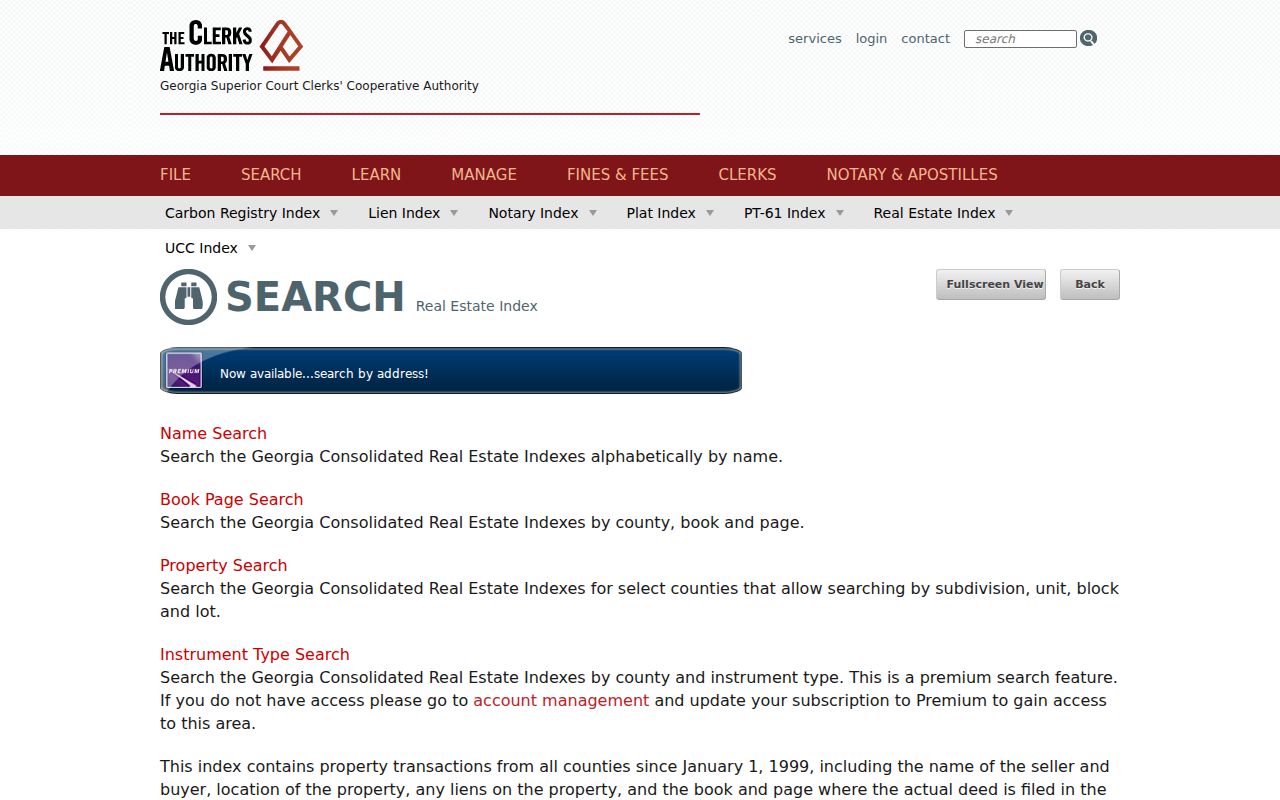
The statewide index page shows the correct route, but an Echols-specific answer still requires a county-filtered search.
Compare Echols County Property Owner Evidence
A reliable ownership answer states what each source actually says, nothing more. Use the comparison to avoid turning an appraisal, a tax bill, or a GIS map into a title conclusion.
| Source | Ownership clue | Access limit |
|---|---|---|
| Echols qPublic | Published tax-card owner or taxpayer lead, situs, mailing, parcel and value fields if displayed | Live fields blocked during research; office fallback |
| GSCCCA and Clerk | Recorded grantee, instrument, book/page and legal description | Images may require an account or Clerk request |
| Tax Commissioner | Tax-year bill recipient, balance and delinquency | Does not set ownership or assessment |
| Probate Court | Estate, will, heir, or order clues | Current copies require a local request |
None of these sources proves occupancy. The owner of record, the occupant, the tax bill recipient, and the mailing addressee can all be different people or entities.
Read the Echols January 1 Owner Rule
Echols County taxes on a January 1 rule. Whoever owned property on January 1 receives that year's tax bill. The Tax Commissioner explains this. That holds even if a buyer closes later in the year. The deed-filing address comes from the owner or attorney. Address changes made before August 1 go to the Assessor. They apply the next year. An already issued bill is handled through the Tax Commissioner.
One parcel, several valid dates. Label the recorded grantee and recording date, the qPublic owner and digest date, and the tax-year bill recipient separately. A later buyer may hold the latest deed while the January 1 owner remains on the year's bill.
This timing rule is why "who owns" should never be answered from a bill alone. The Tax Commissioner at 149 Highway 94 E, Statenville, 229-559-5253 handles bill questions. The Assessor and the Clerk hold entirely different evidence.
Identify Echols Estate and Company Owners
When the grantee is an LLC or corporation, preserve the entity name exactly. Then use the Georgia Secretary of State business search for the business name, control number, status, registered agent, and any listed officers. Those fields identify the entity and its public contact. They do not transfer the real estate or replace the deed. Estates need a different path. If an executor or heir appears as owner of record, Echols Probate Court and the Clerk become the key offices. Georgia probate material through 1990 is available as an archival lead through FamilySearch. Current copies come from the local court. Compare any probate order against the deed's parties, dates, book and page, and legal description before attributing ownership.
- Recorded grantee
- The party receiving an interest in the indexed deed.
- Owner of record
- The owner label published in a named official record as of its date.
- Registered agent
- A public entity contact, not automatically the real property's individual owner.
Request Missing Echols County Owner Records Narrowly
When qPublic is blocked, contact the custodian office directly. A deed image sitting behind an account wall calls for the same step. Give the road or situs, any known party names, and an approximate date. Add an acreage or legal-description clue and the exact item needed. Name the record. A parcel card, recorded deed image, plat, or dated map. Each lives with a different office. That specificity beats asking for everything about an owner. The county open-records form permits inspection or copies. It asks for a detailed description plus contact information. Georgia's framework gives the agency three business days to respond. That is a response deadline, not a delivery guarantee. Existing nonexempt records can be requested. The office does not have to create a new ownership analysis for you.
Know Echols County Owner Lookup Limits
Echols County property records answer some questions and not others. A tax card can name an owner of record. A deed index shows who received a parcel. A tax bill tells you who pays. None of that proves who actually lives at the address today. It also cannot settle every competing interest in the land. For real certainty about title, only a formal title examination will do.
History adds another wrinkle. Official county pages give two dates for the courthouse fire, 1897 versus 1898. Both accounts describe substantial record loss. Anyone digging into early ownership should expect gaps from that disaster.
Use ownership data for a legitimate property purpose. Do not repurpose mailing, owner, or other record data to track, stalk, harass, threaten, or harm a person. Keep sensitive personal details out of notes and publications.
A gap is not a verdict. Before concluding that no earlier owner existed, check the Clerk, the visible 1981-1993 Echols grantor-index scan, Georgia Archives guidance, and FamilySearch. What looks like missing history may only reflect access or record survival.