
Echols County Ownership Sources
Tracing former owners of an Echols County property means walking the deed chain backward. Go one seller and buyer at a time. Start with the most recent recorded deed. The tax card may give a current owner of record and a parcel number. But the deeds carry the legal transfer history. Older Echols County ownership research can pull in deed books, plats, and estate files. It can even reach old road names. To search Echols County property records by address, first pin down the parcel number. Then date every finding. The assessor roll, the recording index, and the tax bill rarely update on the same schedule.
| Source | Coverage clue | Keeper | Best use |
|---|---|---|---|
| Deeds and plats | Check county-specific dates | Clerk and GSCCCA | Transfers and book/page links |
| Echols grantor index | Path labeled 1981-1993 | Kofile-hosted scan | Party, description, book, and page leads |
| County microfilm | Older surviving material | Georgia Archives and FamilySearch | Deeds, estates, taxes, and court minutes |
| Road index and plats | Varies by record | Assessor and Clerk | Match old descriptions to place |
Begin with the newest transfer you know. The GSCCCA Real Estate index is the natural modern entry point, though its Echols-specific good-from and through dates control what it covers. An older question may require the index, its cited book, and then the archives.
Walk the Echols Deed Chain
A backward chain follows people and instruments, not just an address. Each deed names a grantor and a grantee. The legal description, recording date, instrument type, and book and page keep the right tract attached as names and roads change over the years.
- Find the latest purchase deed. Search the present published owner as a grantee, meaning the buyer or recipient.
- Read that deed for the grantor, the seller or transferor, and copy its legal description and book/page.
- Search that grantor as an earlier grantee. Compare descriptions before accepting the result as the same land.
- Repeat until online coverage ends. Then request the cited book from the Clerk or use archival material.
- Grantor
- The person or entity transferring an interest.
- Grantee
- The person or entity receiving that interest.
- Chain of title
- The ordered run of instruments affecting the land.
- Legal description
- The deed text identifying the tract by acreage, bounds, lot, or plat.
Echols Index Versus Deed Image
An index hit is only a finding aid. It gives parties, instrument type, recording date, and book and page. The image supplies the operative words, signatures, consideration clues, reservations, and the full legal description. When that distinction matters, former-owner research needs both.
GSCCCA publishes several statewide date clues, but none proves Echols completeness. The project began operating in 1999, and other material discusses older additions. Check the county coverage notice, or call the Clerk at 229-559-5642, before treating a blank result as a missing transfer.
The official book and page search shows how a citation leads toward an instrument image.
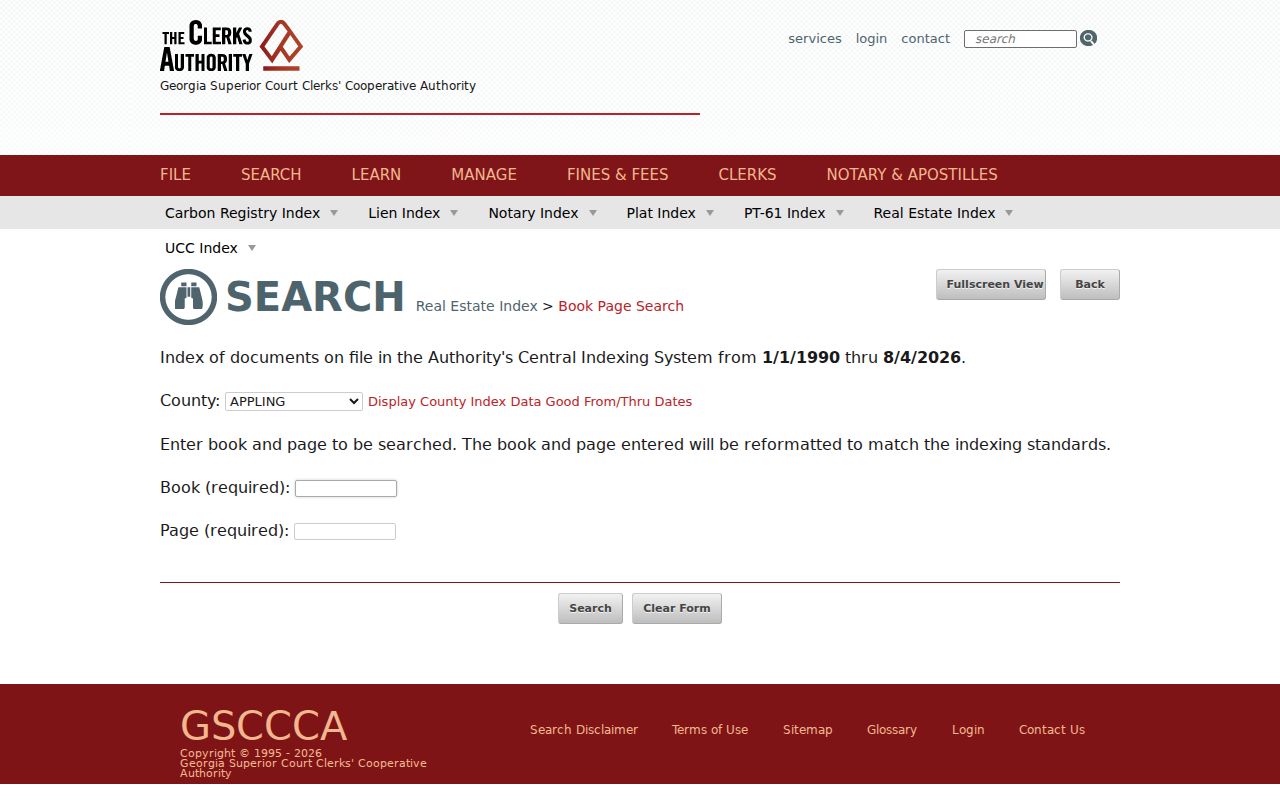
Carry the exact county, book, and page from the index result into the deed image. A visually similar tract is not enough; verify the parcel details match before relying on the record.
The 1981-1993 Grantor Clue
A Kofile-hosted Echols grantor-index path is labeled 1981-1993. Its visible fields include party, property description, book, and page. It can bridge former owners across that span, but it does not prove every instrument is present. The Clerk remains the custodian.
Read the front index first, then turn to the cited entry. Copy spelling and initials exactly. Search reasonable variants afterward. A lead becomes solid when its book and page reaches an official image or Clerk copy whose legal description matches.
Note: A blank name search can reflect spelling, coverage, or indexing limits rather than no earlier owner.
Echols County's Fire Gap
Two official pages disagree on the courthouse fire year. The county history says 1897. The mission page says 1898 and reports that few older records survived. Preserve both claims rather than silently picking one.
A missing deed can reflect destruction, an unindexed book, or a gap in online imaging. Echols County was formed in 1858 from Clinch and Lowndes counties, so a truly early chain may point to predecessor-county records. The recording county and the legal description remain decisive.
Extend Echols Ownership Offline
Georgia Archives guidance identifies deeds, estates, tax material, and court minutes among county sources. It recommends the FamilySearch Catalog under Georgia, Echols, and record category. Many images are browse-only. An index sits at the front of a volume.
Archives guidance generally places post-1900 county records with the county. Use the Clerk for later deeds. Try Archives microfilm or FamilySearch for earlier surviving books. Estate transfers may require Probate Court files. Heirs can receive interests without any sale deed.
The Georgia headright and bounty collection spans 1783-1909. It offers acreage and location clues. An entry is not direct proof of a modern parcel chain.
Road Names Recover Property History
Rural land often appears by acreage, bounds, creek, road, or adjoining tract. It may lack a modern street number. Echols County's road index helps compare an old name with a current route. A plat may add lot, block, easement, and survey references. Neither map overrides a recorded description.
Build a log with date, grantor, grantee, instrument, book and page, description, and source. Include a next action. Keep execution and recording dates apart. A later assessor date belongs in one field. The Tax Commissioner's January 1 bill-recipient date belongs in another. That date ladder keeps one owner label from standing for every purpose.
A modern highway number may not match the wording in an older deed. Compare the county road index, state-route notation, newspaper place names, adjoining tracts, and survey calls. Never modernize the deed text in your notes. Retaining its original wording makes later searches reproducible. It may also expose a spelling or route-name variant that unlocks the prior link.
Plats add another path. A lot-and-block deed can point to a recorded subdivision sheet. A metes-and-bounds deed may cite a survey or an earlier instrument. Follow every express book and page reference. The same acreage may appear under different road labels. Shared boundary calls and adjoining-owner names can then be stronger identity clues than the street address.
Limits of Echols Former-Owner Records
Stop the chain where the evidence actually holds. A guessed first owner helps nobody. Echols County's formation, the courthouse fire, spotty online coverage, and plain name variation can each break the visible chain of title. Write down every gap and note which collection still needs a search. For certified proof or a title opinion, rely on official records and qualified help.
Former-owner research supports house history, estate work, boundary diligence, and purchase review. It does not reveal who occupies a home today. A mailing address never proves residency.
Not every recorded instrument is a sale. Security deeds, releases, liens, and corrective instruments can sit between ownership deeds and explain a name change, a legal-description fix, or a financing event. Keep the instrument type visible in your chain table. When an estate or heir shows up, turn to Probate Court sources instead of forcing a simple seller-to-buyer story.
The Clerk of Superior Court sits at 110 Highway 94 E in Statenville, open on the county's published weekday schedule. A precise request should name Echols County, the party name variants, the approximate recording period, the instrument type, and any known book and page. Ask for the index entry or the instrument image, never a legal conclusion. The Clerk cannot practice law.
Treat outside sources as corroboration only. Georgia Historic Newspapers can surface legal notices, estates, sales, and older place names. The local Historical Society museum and the county library may hold uncataloged family or land material, though Echols County publishes no online obituary index or digitized city-directory run. A newspaper notice or family file is a clue, not a substitute for the recorded conveyance. Cite the publication date, page, and repository, then tie the name back to a deed description. Where evidence conflicts, record both claims and rank them by source authority rather than smoothing the conflict away.
Lawful use. Use Echols County former-owner records for legitimate property research. Never use names or addresses to track, threaten, or harass a living person.