
Read Echols Deed Records
The Clerk of Superior Court keeps Echols County deed records. The Georgia Superior Court Clerks' Cooperative Authority indexes them online. The Clerk is the custodian. A recorded deed names the parties, states the form of transfer, describes the land, and carries a book-and-page or similar recording reference. That reference is the core evidence of a transfer. Still, one deed is never the whole story. Later instruments can change or burden the interest. So read the deed alongside the records that followed it. Security deeds, releases, liens, plats, and tax instruments stay separate records. A single index may still help locate them all.
| Deed Type | What It Does | Common Use |
|---|---|---|
| Warranty deed | Transfers the described interest with stated title promises | An arms-length land sale |
| Quitclaim deed | Conveys whatever interest the signer holds, without a broad title promise | Family transfer or title cleanup |
| Executor or administrator deed | Conveys property under estate authority | Probate administration |
| Tax deed | Records a transfer following the statutory tax-sale process | Delinquent-tax proceeding |
| Security deed | Secures a debt against the described land | Financing, not a normal sale deed |
Labels matter in deed records. A security deed or lien can burden the land without ever serving as the buyer's purchase deed. A release cancels a prior security instrument. A plat shows surveyed features and references, yet it does not prove the full ownership chain. Search the index broadly first. Catch related instruments in the net before you draw any conclusion from a single document. Then open the images and log each citation.
Echols Clerk And GSCCCA Access
Deeds, liens, and plats in Echols County rest with the Echols County Clerk of Superior Court. The courthouse office sits at 110 Highway 94 East in Statenville. It answers at 229-559-5642. For online work, the GSCCCA real-estate index is the main route into Echols deed records. Its public material sets no single reliable earliest online year for this county. Rely instead on the county-specific good-from and through notice. Or ask the Clerk before concluding that an older deed is missing.
On pricing, the GSCCCA account comparison shows limited use covering index and summary access only. Images and printing are reserved for higher tiers. Other account levels and single-use access carry their own costs. Buy just the access you need. When a certified copy matters, request one from the Clerk. Certification authenticates the reproduction, while a screen result is only a search lead.
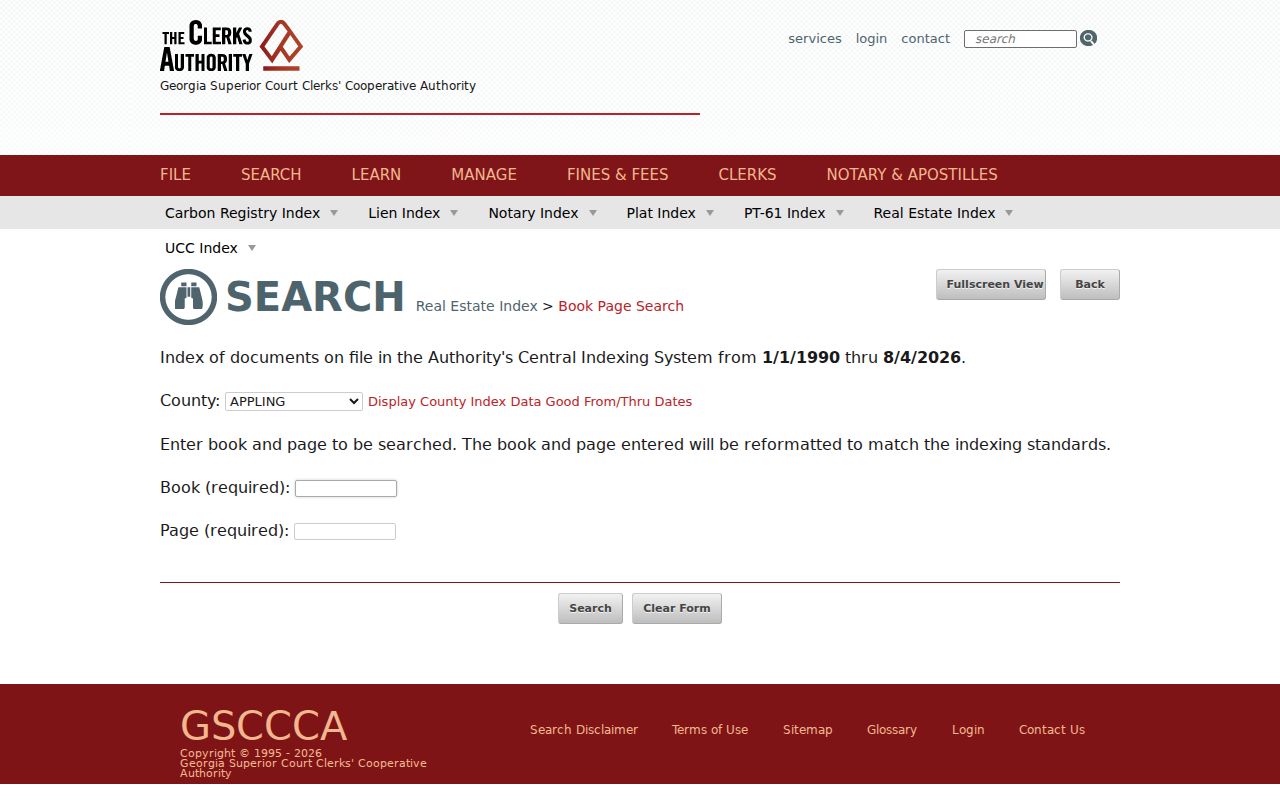
The book-and-page form shines with an exact citation in hand. It turns a parcel-card or index reference into one focused deed request.
Use Echols Grantor-Grantee Records
A grantor transfers an interest in land. A grantee receives it. One owner often appears as buyer in one deed and seller in the next, so search both roles. The GSCCCA name search makes this straightforward. Select Echols County, enter last name then first for an individual, and start with a broad instrument choice and a wide date span. Narrow the search only after a likely entry appears.
- Find the current owner's purchase deed with that owner listed as grantee.
- Open the deed and record its grantor, date, instrument type, book, page, and legal description.
- Search that grantor as a grantee to locate the earlier acquisition.
- Repeat while the land description remains consistent, and label every gap instead of guessing.
- When the online run ends, take the last sound book-and-page lead to the Clerk, Archives, or microfilm.
- Grantor
- The party transferring an interest.
- Grantee
- The party receiving an interest.
- Chain of title
- The ordered sequence of recorded transfers tied to the same land.
- Book and page
- The citation used to locate an instrument in the recorded books or image system.
Every hit deserves a full capture. Record the county, party names, instrument type, index or record date, book and page, property description, cross-index reference, consideration if displayed, and image status. The parcel number orients the search. The deed's land description and recording reference form the stronger bridge from one chain link to the next.
Echols 1981-1993 Grantor Scan
A vendor-hosted Echols grantor-index PDF sits under a path labeled 1981-1993. The scan shows party, description, book, and page columns. It bridges years a modern name search cannot reach. Even so, the file does not prove that every instrument or book from those years is present.
Use the front index to find the family name. Copy the full entry and its book-and-page citation. Take that citation back to the Clerk or the official image system. Keep a source column in your notes so the vendor scan stays a lead and the Clerk copy stays the evidence. Also test initials, spelling variants, and both party roles.
Note: The scan's date label is a coverage clue, not proof of a complete Echols deed run.
The Echols Courthouse Fire Gap
Official county pages agree that a late nineteenth-century courthouse fire devastated Echols records. They disagree on the year. The county history page says 1897. The county mission and history text says 1898 and reports that few earlier records survived. Record both dates in careful deed notes. Picking one without attribution hides a genuine source conflict.
The gap changes what an empty deed search means. The first instrument you find may simply be the first surviving or indexed item, not the first transfer of that land. Echols County was created in 1858 from Clinch and Lowndes counties, so an older trail may lead into predecessor-county or state land records. Follow the land description, not just the modern county name.
Older Echols Deeds Beyond Web
For deeds that predate online access, the Georgia Archives research guide is the starting point. County holdings there may include deeds, estate files, tax records, and superior or probate minutes. The FamilySearch workflow it describes starts in the Catalog. Limit results to online material, then choose Georgia, Echols, and the record category you need. Images are often browsable rather than searchable. A handwritten book index may sit at the front of a volume.
Records created after 1900 generally stay with the county. So later Echols deed records route first to the Clerk of Court. The Virtual Vault can add selected maps or state material. Legal notices and local context come from Georgia Historic Newspapers. None of these substitutes for a recorded deed itself. The local Historical Society and library remain useful referral points. They cover city directories and obituary indexes.
Request an Echols Deed Copy
A copy request works best with an exact book and page. Add the instrument type, party name, and date if you know them. Search the online summary first. Then use the Clerk counter, phone, mail, or a written public-record route for an image or certified copy. Echols publishes no deed-copy fee schedule online. Ask the Clerk for the current cost and delivery options. Do not rely on a fee from another county.
A Georgia Open Records request should describe an existing instrument, index entry, or book page. State guidance generally calls for a response within three business days. When production takes longer, the agency sends a written time and cost estimate. It need not create a chain-of-title report. Keep the request narrow. Also ask for redaction of protected personal data. It should have no bearing on the land question.
Recorded, not guaranteed. Echols deed records show what reached the recording system. They do not rule out an unrecorded interest or replace a professional title opinion.
Monitor New Echols Filings
The statewide Filing Activity Notification System is known as FANS. It offers forward-looking notices tied to filing activity. It can alert a property owner to a new index event. It is not a guarantee against fraud, though. It also does not replace review of the official deed record. Its terms restrict misuse for harassment, stalking, improper research, and commercial activity.
Treat an alert as a prompt to inspect the actual indexed instrument. Confirm the county, party name, instrument type, book and page, date, and land description. A common name may produce an unrelated notice. Save the alert date and the official result together. That way later research can distinguish the notice from the filed image. If a filing appears wrong, contact the Echols Clerk promptly. Then seek legal advice on the proper response. The alert service cannot cancel or correct a recorded document.