
Search Echols Property Records
Let the clue you already hold pick the tool. An address points to the county's Schneider qPublic search, which ties a situs (the spot where land actually sits) to its assessment record. Have a name instead? Run it through both the assessor search and the deed index at the Georgia Superior Court Clerks' Cooperative Authority, better known as GSCCCA. A book and page citation goes directly to the GSCCCA book/page form. Expect no single lookup to settle everything.
Dates matter as much as facts. A tax card, a recorded deed, a bill, and a plat can each describe a different moment in the parcel's life. Note the date on every record you pull. From there, follow the official chain:
- Normalize the street through the county road index and try qPublic.
- Save the parcel, situs, owner label, values, and record date shown.
- Search GSCCCA for the latest grantee and matching deed reference.
- Ask the Tax Commissioner about bills, payment, or a recorded FiFa.
- Compare a map or plat with the deed when acreage or lines matter.
Echols Property Records Offices
Three offices in Statenville split the property records work. The Clerk of Superior Court records real-estate instruments. The office is also the local route to deed books, plats, liens, and certified copies. The Tax Assessor keeps the appraisal roll and reviews changes to land and improvements. The Tax Commissioner sends out bills and collects the tax. Call the office that owns your question. That habit alone prevents mix-ups. It stops you from treating an appraisal entry as title proof or a deed as a paid-tax receipt.
The Clerk and Assessor are open Monday through Friday, 8:00 a.m. to 4:30 p.m. The Assessor closes for lunch from noon to 12:30. Confirm hours before traveling. Mail reaches the Clerk at P.O. Box 213 and the Assessor at P.O. Box 326. A narrow Georgia Open Records Act request is the fallback for any county record without a public search screen.
Echols Address Search Keys
Rural address work goes better with a three-key file. The keys are street or situs, owner name, and parcel identifier. Search each key where it fits instead of forcing an address into a grantor index. The official Echols Road Index reconciles Highway, GA Highway, and State Route variants. It also reconciles direction and old road-name variants. When an older deed uses a label a current map has dropped, keep the deed's wording.
| Known clue | First record | Then verify |
|---|---|---|
| Street address | qPublic tax card | Deed legal description |
| Owner name | Assessor and GSCCCA | Latest instrument image |
| Book and page | GSCCCA book/page form | Clerk copy |
| Rural place name | Road index and county map | Parcel or legal description |
Do not assume a parcel-number pattern for Echols without seeing one documented. The county's qPublic screen may not load, and its exact search labels, owner field, and identifier format are not published elsewhere. If the portal fails, give the Assessor the address variants and request the parcel card, valuation history, and legal-description field.
GSCCCA Deed Search Fields
The statewide GSCCCA name search is the main online route into Echols deed records. Select Echols County first. Then choose a party type and enter a last or company name. Narrow by instrument and date when useful. Run the person or entity as both grantor and grantee. A grantor gives an interest; a grantee receives one. Searching only one side can hide the deed that connects a chain.
| Search control | Practical use | Caution |
|---|---|---|
| County | Limit results to Echols | Expand only with a reason |
| Party type | Grantor, grantee, or both | Roles change by instrument |
| Name | Person or company index | Try spelling and entity variants |
| Instrument type | Separate deeds, liens, releases | A security deed is not a sale |
| Date range | Focus the result set | Check coverage dates first |
A known book and page can be checked in the book/page search. GSCCCA may reformat an entry to indexing standards, so keep the original notation too. Images and deeper access may require an account or fee. For a certified copy, the Clerk remains the authority.
The official GSCCCA real-estate search screen is the statewide starting point. Any Echols party search begins there.
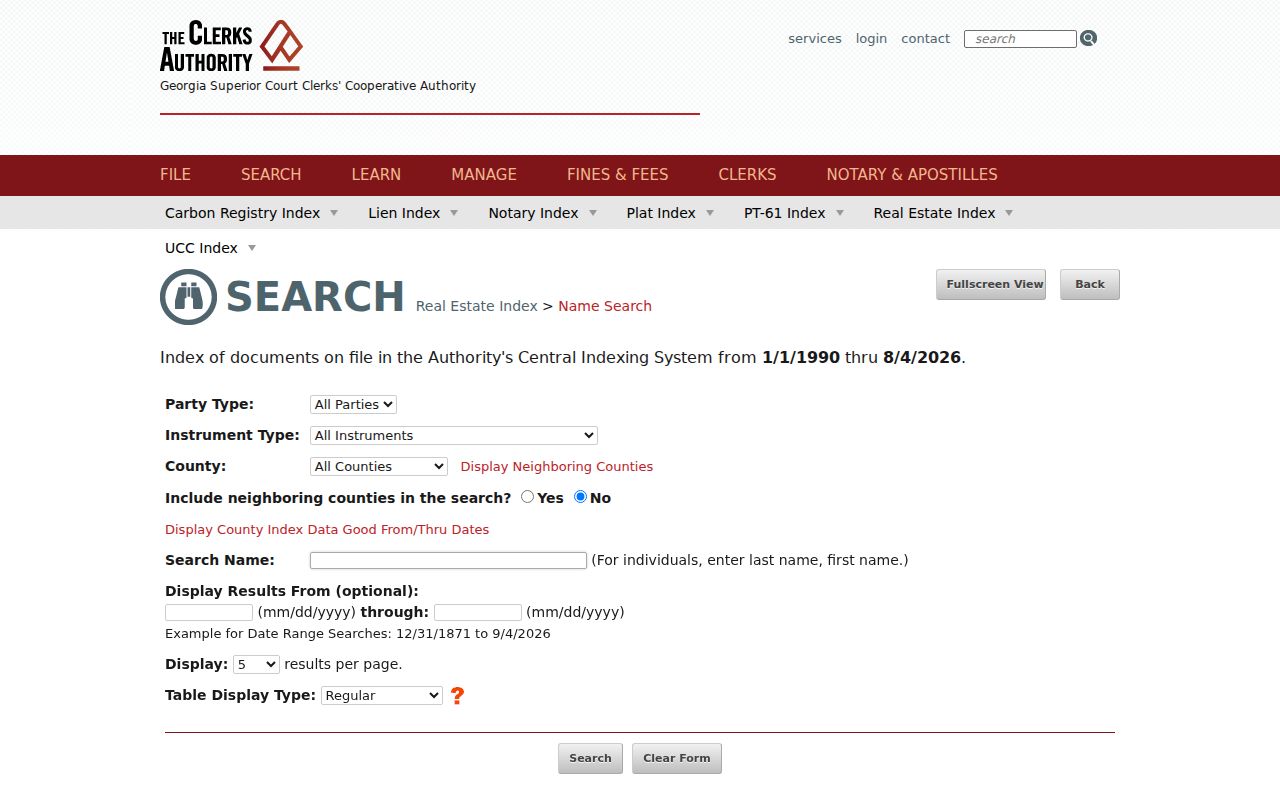
That search page shows the query surface itself, not an Echols result or proof of ownership. Select the county, then inspect the dated record it returns.
Echols Property Record Types
Each record set answers a different part of the property story. Deeds document transfers. Security deeds and liens show recorded claims. The assessment roll supports valuation and tax administration, while the tax office tracks billing and collection. Maps and plats describe place and shape. Court and probate files may explain a transfer that never looked like an ordinary sale.
| Record | What it supports | Custodian or route | Access path |
|---|---|---|---|
| Deed or plat | Transfer and legal description | Superior Court Clerk | GSCCCA, counter, or copy request |
| Assessment | Owner label, use, and value | Tax Assessor | qPublic or parcel-card request |
| Tax bill | Charge, due date, and collection | Tax Commissioner | Office and county bill guidance |
| Court or probate | Dispute, estate, or ordered transfer | Clerk or Probate Court | PeachCourt, counter, or request |
| Map or road index | Parcel and address orientation | Assessor or county | County resources and qPublic |
See the Echols County deed records page for instrument mechanics. The assessment and bill split is covered under Echols property tax records. The map route has its own page on Echols parcel maps.
Echols Tax Dates Differ
An owner label can shift with the office keeping it. The current owner, the tax-card owner, and the bill recipient may be three different names. Under the Tax Commissioner's rule, the deed owner on January 1 receives that year's tax bill. A purchaser who closes later does not change that. An address change made before August 1 goes to the Assessor. It takes effect the next year. A correction to a bill already issued belongs with the Tax Commissioner. Keep the tax year and as-of date with any owner statement you write down.
A four-date record ladder
Execution date: when a deed was signed. Recording date: when the Clerk indexed it. Roll date: the effective date of the assessor record. Tax year: the year tied to the bill and the January 1 owner rule.
Bills go out by September 15. Payment is generally due November 15, though the date printed on your own bill always controls. An unpaid account can lead to a FiFa, Georgia's tax execution, and a recorded lien against the parcel. Check payment and enforcement status with the Tax Commissioner.
Echols Appraisal Records Change
Appraisal cards change for many reasons. Between January 1 and July 1, the Assessor reviews construction, homestead applications, agricultural covenants, additions, remodeling, permits, taxpayer returns, deed transactions, deletions, and owner requests. Sales data and assessment-ratio studies also drive the Board of Tax Assessors' updates and revaluations. So a card can shift without any new arms-length sale.
A 2025 county notice described field appraisal work running from June through December. It mentioned a white Ram truck with tag CTA 2683 and yellow vests. That description belongs to that notice alone. Before trusting any claimed identity, call the Tax Assessor at its published number. Check the current county notice.
Record every value field you see. Note land, improvement, total market, assessed, taxable, exemption, and tax-year figures whenever they appear. Never fill a missing field with a countywide average.
Echols Parcels Are Rural
Echols is big and empty. It spans roughly 420 square miles. It carried just 8.8 people per square mile in 2020. County plans treat forest and agriculture as the major land uses. One county description puts more than 90 percent of the land in forest held by private companies. A search here can turn on acreage, timber ownership, agricultural covenants, or metes and bounds. A tidy subdivision grid is the exception.
Several unincorporated communities show up in records and local references. Fruitland, Haylow, Howell, Needmore, Potter, and Tarver can help decode an address. They can also decode a newspaper notice or an old place name. None of them is a municipality or a recorded subdivision. Statenville serves as the unincorporated county seat. Its property records are county records as well. No separate city assessor, recorder, permit portal, or tax digest exists.
For a large tract, record the acreage and land-use or covenant status. Record the exact deed description and a plat or survey reference too. The tax map identifies the tract. Only the deed, recorded plat, and professional survey settle a title or boundary question.
Echols Maps Need Verification
The county resources page links a county map, a large map, and the road index. It also offers the qPublic parcel route. All are useful for orientation. Echols publishes no documentation of the portal's live layer list. The aerial imagery, flood or zoning layers, adjacency tool, and export controls are also undocumented. Confirm the features before counting on them. Don't assume a familiar Schneider feature appears in the Echols portal.
Planning sources need dates too. A 2020 plan described the county as having no zoning. It cited a 2006 subdivision ordinance. A 2024 notice later announced a hearing on a proposed zoning map. The 2025 plan was adopted on July 10, 2025. Ask which ordinance or map was effective on the date relevant to the parcel. For planning or map records not online, send a specific county request. Name the property, record type, and date span.
Map limits. A GIS polygon is an assessment and orientation aid. It is not a legal survey, and a parcel across a road is not automatically an adjoining tract.
The Echols Fire Gap
Echols County dates to 1858. The surviving record chain does not start cleanly at formation. Two official county pages place the courthouse fire in different years, 1897 and 1898. Both describe grave record loss. Citing both years beats picking one without support. A blank early index never proves an earlier owner or transfer was absent.
A vendor-hosted grantor index covering 1981 through 1993 shows an older working method. Find the surname in the front index. Then read the party, property-location or description, book, and page columns. For deeper gaps, the Georgia Archives and FamilySearch may hold county books or microfilm. Any lead that affects title should go to the Clerk for confirmation.
Always add a source and coverage column to a chain. Labels like “not located online,” “fire-era gap,” and “book requested” say exactly what the evidence shows.
Echols Deed Alerts
GSCCCA's Filing Activity Notification System, or FANS, is a statewide, forward-looking alert service. It notifies a registered user of matching filing activity. It does not certify title, prevent a filing, or prove fraud. Its terms also restrict research and misuse. Treat an alert as a prompt to pull the official instrument and contact the Clerk.
This tool answers a different need than a backward chain search. GSCCCA and deed books show what is already indexed. FANS watches for later matches. A worried owner should keep the alert. Note its date and instrument reference, retrieve the official record, and seek qualified legal help when needed.
Echols Open Records Requests
Not every Echols County record sits behind a search box. For material with no online portal, the county's open-records form is the doorway. It asks whether you want inspection or copies. It gives room to describe the property record. It also collects contact details along with your preferred access time. Search and retrieval are free for the first fifteen minutes. Standard letter or legal pages cost ten cents each. Nonstandard media is billed at actual cost.
The form operates under the Georgia Open Records Act, O.C.G.A. §§ 50-18-70 through 50-18-77. Citing § 50-18-71, it notes that prepayment may be requested when an estimate tops $500. It may also be requested when unpaid bills remain. An old form yields to current law and the custodian's current estimate. Strong requests name the parcel, deed, or plat, the record type, and a date range. Say whether inspection or an electronic copy will do.
Avoid sending one sweeping demand for every property record. The Assessor holds parcel cards and valuation history. The Clerk keeps deeds and plats. The Tax Commissioner tracks billing status.
Limits of Echols Property Records
Echols County property records can answer a lot. They reveal a published taxpayer or grantee. They reveal assessed values, legal-description clues, recorded liens, and mapped parcel context. They cannot guarantee clear title. They cannot surface every unrecorded interest, fix a surveyed boundary line, or state a present sale value. Expect an LLC, trust, estate, or representative where a person's name should be. A mailing address may also differ from the situs, and the land stays the same.
Public access carries limits. Keep every property search narrow. It should be as narrow as the deed, boundary, estate, tax, or civic question requires. Confirm important findings with the custodian, and skip republishing personal contact details. In January 2026 the GBI reported allegations of misused local license-plate data. The data was tied to stalking-related conduct. The case was an arrest report, not a conviction. Still, it shows why lawful property research should stay separate from tracking people.
Lawful use. A public owner label is not permission to stalk, harass, threaten, or harm anyone. A records lookup also does not replace a Georgia attorney, title examiner, appraiser, or licensed surveyor.